Rewatching Gary Hustwit’s Design Trilogy in 2026
The Criterion Channel is currently hosting the streaming premier of Gary Hustwit’s 2025 documentary Eno. The conceit of Eno, a look at the musician, artist, and thinker-at-large Brian Eno, is that is not a traditional documentary but a “generative” documentary; Eno, Hustwit, and a team of developers created an AI algorithm that creates a new documentary upon every watch. On the Criterion Channel, they are releasing a “new” version of the documentary every month. I watched the June version, my first experience with the film, and found it to be mostly fine. I’m not sure I heard Eno say anything I hadn’t heard before. I was surprised to find, actually, at least in my version, that Eno was the only voice in the entire film. Structurally, it never really told a coherent story of Eno’s work or evolution. It’s always great to hear Brian Eno think out loud and I always leave an interview, talk, or film about him inspired and excited but I also felt largely unsatisfied at Eno’s conclusion; more interested in what I didn’t get to see than what was included. In what my cynical brain tells me is a type of attention-fracking, I’ll likely watch the new July version too to compare. I can never get enough Eno!
For designers, of course, Gary Hustwit is likely most know for his Design Trilogy, the three documentaries he made between 2007 and 2011 that focused on graphic design, industrial design, and urban planning, and in support of Eno, Criterion is streaming all three of them as well, along with his 2018 documentary on Dieter Rams. Helvetica, — the first of the trilogy, the one closest to my work, and the one I’ve watched the most — was released my first year of design school and felt like, at the time, an exciting introduction to the world I was about to enter. I loved it. But I hadn’t watched it in probably fifteen years and I wasn’t sure I’d seen his follow ups, Objectified on industrial design and Urbanized on urban planning, since they were released. I was curious to see how they held up and what my reaction to them would be, after all these years.
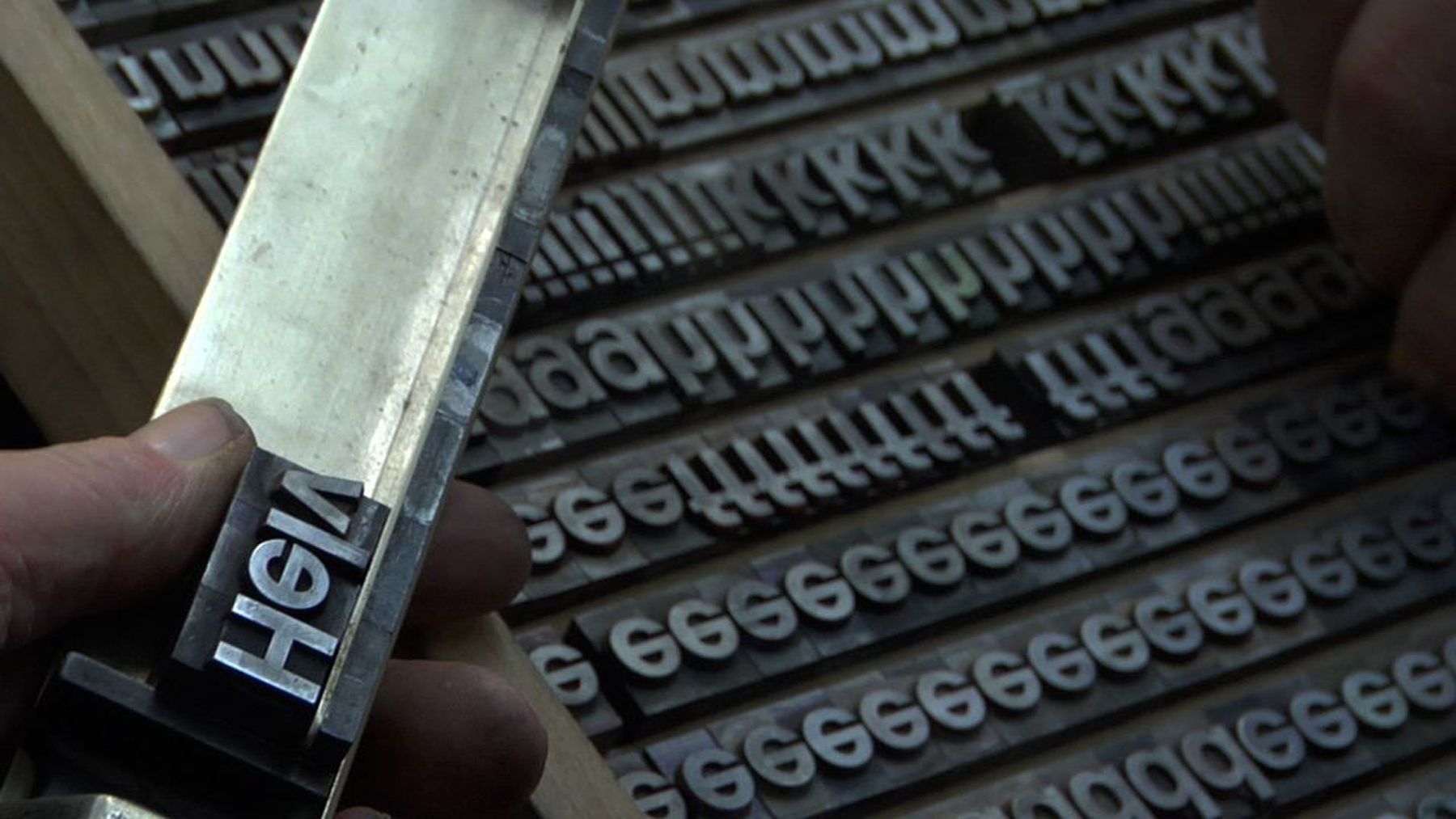
Hustwit immediately sets the tone — crisp cinematography by Luke Geissbuhler, an El Ten Eleven-driven soundtrack, and a collection of charismatic, passionate talking heads that can’t help but make you interested in an otherwise esoteric topic: the font Helvetica. Within the first few seconds, I had a moment where I thought I might be taken back to college, where I could be reminded of what got me excited about graphic design in the first place. Instead, the feeling I had as Helvetica progressed was of a design world that feels like it no longer exists. Michael Bierut wrote at the time on Design Observer, in a post called Our Little Secret, “I have high hopes that this will be the moment that our field finally breaks through to the general public.” Indeed, watching it in 2026, I was struck by how insular the film feels, how quaint it all sounds to be talking about the curves of letters and shapes of logos. In 2007, it felt like this world was big. In 2026, I couldn’t help feeling how inconsequential it all seemed.
To be clear, I think this says more about me than about Hustwit’s filmmaking, but this feeling carried over to the other films. In each successive film, Hustwit slightly opens his aperture to examine larger forms: from typeface to industrial design to cities. Objectified, his film focused on industrial design, I think might be the strongest of the trilogy: it’s a perfect balance between focus and expansion, an ample playground for Hustwit to explore how the objects we surround ourselves with influence our lives. Unlike Helvetica, he spends time thinking about the consequences these design decisions have on our daily lives, the last quarter of the film becomes a critique of consumerism and looks at sustainability and waste. Urbanized, the final film in the trilogy, is the weakest of the bunch. The scale, perhaps, was too big and the narrative felt uncertain of what it actually wanted to say about cities as it jumps from location to location and topic to topic.1
Perhaps as a response to the expansiveness of Urbanized, Hustwit’s return to design in 2018 came in the form of a documentary on Dieter Rams. Rams, of all his films, is the tightest. There’s a clear narrative arc and it clearly and systematically lays out Rams’s philosophy, guided by aesthetics, ethics, and functionality, that has driven his career. What’s lacking in Rams, however, was some sort of contextualization. While there are other talking heads (unlike the version of Eno I saw), those voices were mostly repeating Rams’s idoms and explaining the in new ways, connecting them to his products. There were no counter-voices, no mention of contemporaries who might be moving in the opposite direction, little explanation of why his Ten Design Principles can feel so radical.
Watching them all back-to-back, ending with Rams, I started to have trouble figuring out what Hustwit wants to do with these films, what he wanted to say. They’re not clear celebrations nor are they pointed critiques. They’re neither overly-explanatory nor overly-insular. As I watched them all, the only message I could deduce was simply: everything around us has been designed.
In retrospect, It’s interesting to think that Helvetica was released the same year as the iPhone, a device that would kick-start the app market and largely shift design’s center of gravity from print and branding to apps and digital services. This is all missed in the film — there’s barely a mention of digital design — or any design that appears on screens — save for Rick Poyner’s example of Myspace as a tool to democratize design. Again, that’s not a fault of Hustwit, we’re not asking him to be, nor were his films presented as, a futurism, but a marker of the design discourse at the time. To watch them in 2026, then, is to see them strangely devoid of any politics. There is no questioning of the power structures that inform and influence design decisions. If everything around us is designed, as the films remind us over and over, what are we to do with that information?
In my 2020 review of Abstract, Netflix’s vapid and flat docu-series on design, I wrote:
“The entire globe has been encrusted with a geological layer of design” write Beatriz Colomina and Mark Wigley in their 2015 book Are We Human? Their thesis argues that there is no world outside of design anymore. From the phones that wake us up in the morning to the streets we get to work on; from the building I’m sitting inside at the keyboard I’m typing these words and the app in which they appear all the way to the satellites orbiting our planet, we can’t escape design. Everything was decided by people and many of those people were designers. So for those of us in the profession, this presents two opportunities: we can either educate those outside the design world about why things are the way they are, how design decisions influence our everyday life and illuminate the ideologies embedded in the built world or we can retreat, hiding behind jargon and shamanesque language to retain a type of power, and keep up an appearance of the creative genius conjuring new worlds out of nothing. Abstact, Netflix’s show about “the art of design”, that in October released its second season, and perhaps the biggest platform to talk about this work, unfortunately chose the latter.
Hustwit’s films are better than every episode of Abstract. He find a middle path, somewhere between demystifying and celebration. I’m still glad they exist, even if as markers of an era that no longer exists. They continue to be some of the strongest films on or about design. But it also makes me wonder what a film about design would look like today? How do you both celebrate it and critique it? How do you make this work legible without turning it into magic? That’s the tension for all of us designers today. Maybe Bierut was right: when I finished my binge, I too missed the days when it was just our little secret.
-
Hustwit talks about the evolution of these films and their structures in this great interview for The Criterion Channel. ↩