Self Portrait as a Coffee-Pot is a Brilliant Defense of Art-Making
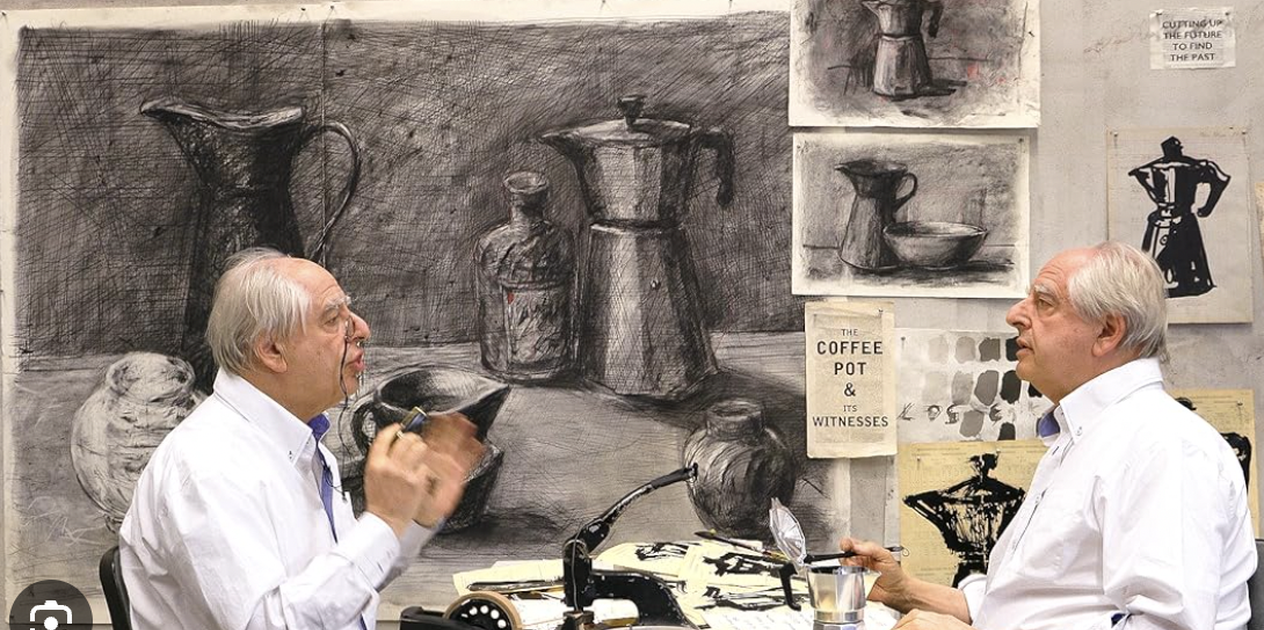
For many of us our worlds suddenly got smaller in March 2020, when the first COVID lockdowns were put in place. No more offices or schools or trains or grocery stores. Instead of venturing out, the world came to us, through video calls and Zoom meetings, news alerts and delivery services. For the South African artist William Kentridge, his world became the studio where he’s made drawings, prints, performances, and films since the 1970s. Confined to the studio, Kentridge did what he has always done: He drew. He painted. He made films. But he also checked in on family around the world — his 90 year old father, his newborn granddaughter — while compulsively following statistics of infections and deaths. He also wrote and directed Self Portrait as a Coffee Pot, a nine-part mini-series that is not just a brilliant record of those early months but also a profound meditation on the studio itself and why we make art. The entire series, which premiered at the Hauser & Wirth gallery in 2024, is now available to watch on the streaming platform MUBI. It’s one of the best defenses of creative practice I have ever seen.
“When I was three years old, I wanted to be an elephant. I failed at that. When I was fifteen, I wanted to become a conductor of orchestras. But then I was told that to be a conductor, you had to read music,” Kentridge says in the opening scene of the first episode. “So, I was reduced to being an artist.” This introduces the tensions of the series: what is the value of art in the face of imaginable tragedy and horrors? Attempting to “do a picture of the whole universe,” he every drawing seemed to result in an image of the Moka Pot he uses to hold his paints. “You start again on another sheet of paper and everything is possible again, and what emgerges but…another coffee pot,” he continues. “Possibility and inevitability. These are the two poles between which a drawing hovers and moves.”
For Kentridge, drawing, specifically, and art, more generally, is a form of thinking. A drawing can be anything; a drawing can make anything. Throughout the series, multiple Kentridges (doubles? companions? doppelgangers?) enter the studio, engaging in dialogues with each other. They debate the merits of his work, often one Kentridge plays the role of the artist, always making and moving, open to possibilities, while the other Kentridge assumes a more critical or editorial role, often appearing as a quasi-therapist, questioning his assumptions and preoccupations.
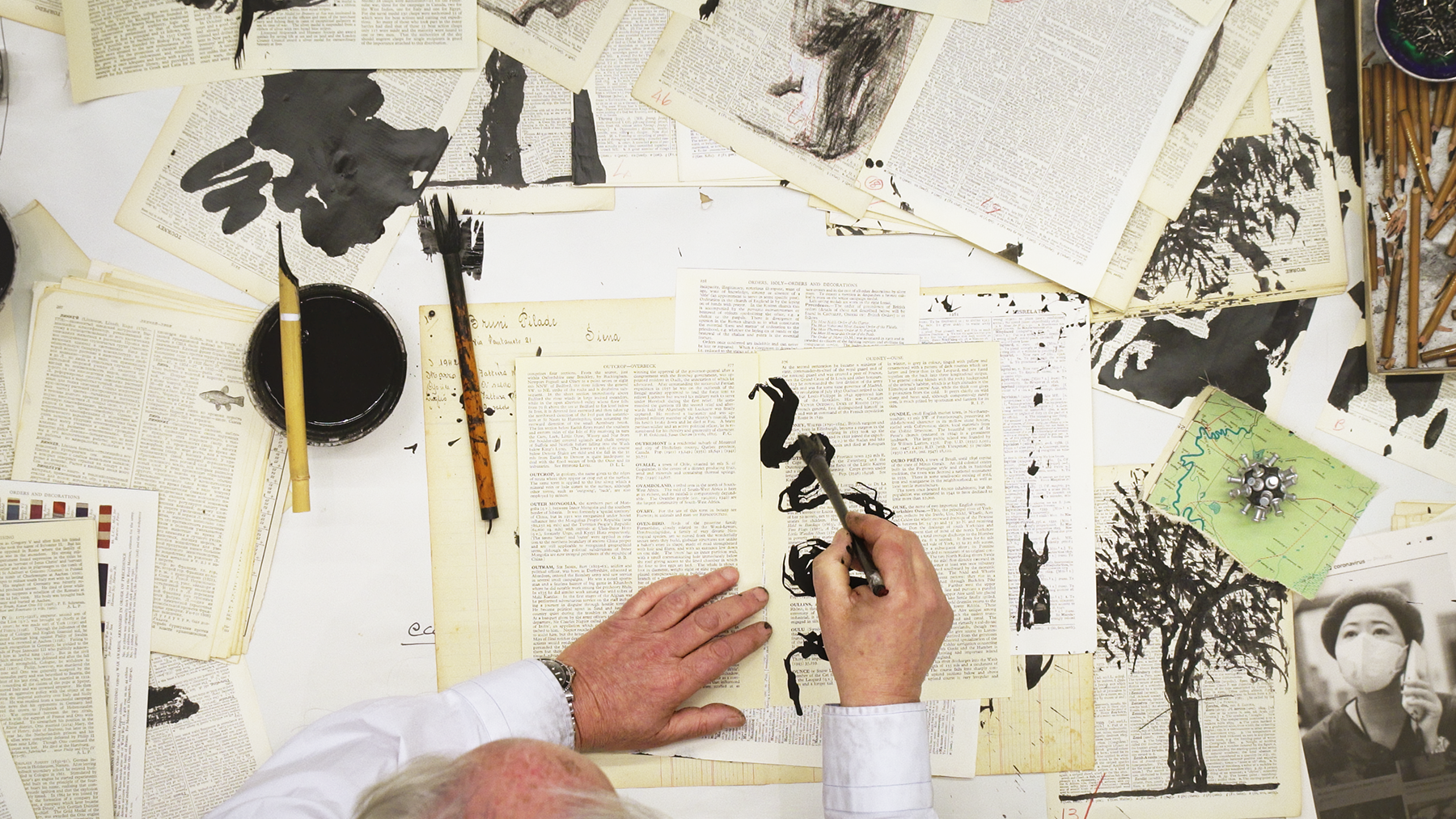
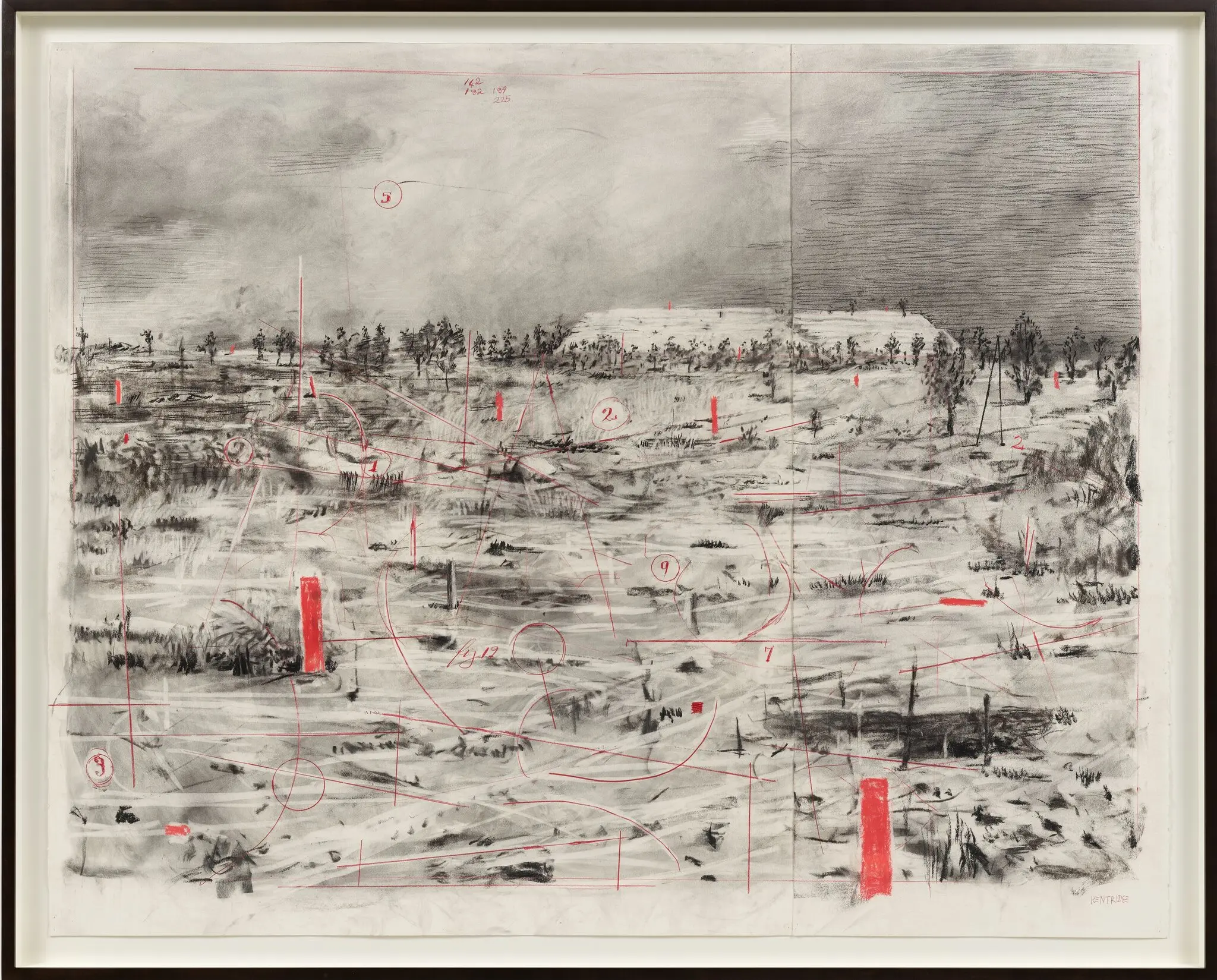
In between these dialogues, we a body of work slowly develop: charcoal drawings of landscapes and bodies, paintings of birds and trees, collages with lines from his favorites books cut out and pasted on top of drawings. He creates stop-motion interludes that turn sheets of paper into crumbled mice who move through the studio and, when he’s able to invite people back into the studio, he stages practice runs of new plays, creating masks and puppets.
For the last fifty years, Kentridge’s work has explored colonialism, the history of violence, apartheid, nostalgia and personal history, and landscape. But his work has also often been about, in my view, art itself. As with so many of the artists I admire, there’s a self-reflexivity to his work, an interrogation of art-making itself. When his charcoal drawings become animated films, we become aware of his lines and marks, he see the process of building up a composition. So much of his work, I’ve come to believe is about the work of making a drawing. (This was also explored in his earlier project, Six Drawing Lessons, a series of lectures delivered at Harvard and later turned into a great book.)
Considering reflexivity, I found myself thinking of the quiet power of the 2011 documentary Gerhard Richter Painting. In that film, we’re given insights into Richter’s process through long, quiet sequences of the artist building up a canvas. Here, too, we’re treated to what feels like an intimate look into Kentridge’s process, watching his hand work and rework the drawings as they get built in shades of greys and blacks with accents of red pencil. Another comparison I kept thinking of was designer and Cranbrook Graphic Design head Elliott Earls’s YouTube channel, Studio Practice. Filmed inside Earls’s studio at Cranbrook, the intimate look at process becomes a guide for artmaking. In both series, the editing and presentation reflect the artist’s work: Earls is a highly frenetic, highly edited series where Kentridge’s is more meditative, almost meandering at times.
These comparisons got me thinking about that phrase, “studio practice”. A studio practice is central to the artists’ process but can seem like a foreign concept for designers. The design fields are structured around “projects” and ideas emerge within the constraint of that project. An art practice doesn’t always have pre-defined projects so a studio practice where one is spending time creating in search of a project is critical. “The central tenet of the studio,” Kentridge writes in the introduction to the book version of Self Portrait, always published by Hauser & Wirth, “is to give the image the benefit of the doubt in the ope that the image is more intelligent than its maker.” Watching Self Portrait as a Coffee-Pot, I found myself thinking about the opportunties of a studio practice, and what that could look like, for the designer. Designers aren’t always encouraged to explore, to create, to make, for the sake of it. It happens, obviously, but it’s not central to how we think about work. I wonder what new ideas, new forms, new concepts of what design can be and what it is for could emerge.
Kentridge describes the studio as “an enlarged head” where ideas can emerge from the edges. The studio is not separate from the world, but a place where the world filters in. Everything that happens in the studio is an attempt to synthesize these inputs: the drawing, the writing, the making, the starting over, the procrastinating. In the studio, anything is possible: a crumbled piece of paper can become a mouse, ink on paper can become an image from childhood, a drawing can become a film, a collage turns into a play, a self-portrait can be, of course, a coffee pot. Everything one makes is a self-portrait of sorts, just as everything unmade is equally a portrait of the artist. This seems to be the argument Kentridge is making: the making is a record of a life lived, a positioning of one’s place in the world.
In the final episode, a marching band enters the studio, forcing Kentridge outside for the first time in the series. The episode closes with Kentridge walking down the road, disoriented, marching band surrounding him. The world enters the studio then the work made in the studio goes back into the world. That’s what art is for: it’s a way to make sense of the world, through a process that doesn’t make sense at all.